Your Next Upgrade as a Technology Leader Is Human




Selecting a technology leader means deciding who can turn the organization’s technology ambitions into results. Technical expertise is an obvious starting point, but how much does it tell us about someone’s ability to succeed in the role, and what else should we look for when selecting and developing these leaders?
To explore that question, we examined over 100 technology leadership success profiles, primarily for executives and function heads, to understand what organizations seek in their leaders beyond technical expertise. Four leadership themes appeared most often:
- Collaboration and relationships
- Communication and influence
- People leadership and development
- Accountability and execution
These themes describe how organizations expect technology leaders to turn expertise into business value: by shaping decisions with colleagues, developing judgment in others, and taking responsibility for results.
Shape the business decision with others
Making a sound technology decision requires knowledge from across the business to assess both what the technology can do and how well it serves the organization’s priorities. Technology leaders bring expertise that helps colleagues understand the technical choices, while colleagues contribute knowledge of the risks and constraints those choices need to address. Bringing these perspectives together makes collaboration and communication central to the quality of the decision.
That combination also stands out in the success profiles we examined. Collaboration and relationships appeared in 80.5%, and communication and influence in 78.8%, making them the two most frequent themes. For example, the profiles ask leaders to:
- Translate technical cyber issues into business risks and investment decisions.
- Challenge senior executives with credibility and tact.
- Partner across technology, business, risk, legal, and compliance functions.
Taken together, these requirements describe a leader who can make a technical choice understandable, invite scrutiny of its assumptions, and use colleagues’ knowledge to improve it. Success therefore requires both confidence in their expertise and openness to having their judgment changed by what others know.
That openness matters because colleagues can agree on the business goal and still have good reasons for preferring different choices. Since they are responsible for different parts of the business, they see different consequences and give different weight to benefits, costs, and risks. Working through those differences gives the organization a fuller basis for its decision, but the technology leader must still help colleagues assess the competing concerns and agree which trade-offs best serve the business as a whole.
Develop judgment in others
Leaders make a lasting contribution when they help others develop the judgment to make sound decisions. By investing in their people, leaders strengthen the organization’s ability to carry its strategy forward and build a foundation for long-term business success.
The profiles reinforce this expectation of developing others: people leadership and development appeared in 70.3%, making it the third most frequent theme. For example, the profiles ask leaders to:
- Coach people in technical and leadership capabilities.
- Empower people to make sound decisions.
- Build a pipeline of technical and business leaders within IT who can execute the organization’s strategy.
Together, these requirements describe a technology leader who helps people develop strong judgement and builds their confidence to take responsibility for the outcomes. Coaching supports that development, while clear decision-making authority gives people opportunities to apply what they learn. A review of research found that empowering leadership was linked with better performance by individuals and teams. Connecting coaching with meaningful responsibility helps people turn growing capability into results.
Developing judgment requires opportunities to take responsibility, while the technology leader remains accountable for the outcomes. Readiness varies across a team, so leaders must decide which decisions people are prepared to own and what support they need to uphold the business’s standards and commitments.
Stay accountable for the business result
Those commitments link people development to accountability: the capabilities leaders build in others need to translate into business results. The technology leader remains responsible for both their team’s performance and creating the conditions that help people succeed.
This connection between outcomes and the leader’s own responsibility is evident in the profiles: accountability and execution appeared in 61.9%. For example, the profiles ask leaders to:
- Balance care with high expectations for results.
- Take responsibility for outcomes and team success.
- Remove roadblocks that prevent performance.
Business demands can grow faster than a team’s capacity to meet them, creating a gap between what the organization needs and what people are equipped to deliver. In responding to that gap, the technology leader must judge how far to stretch the team while keeping its commitments realistic. That judgment matters because meeting a target can conceal the strain required to achieve it, leading the business to mistake exceptional effort for a level of performance the team can reliably repeat.
Assessing what the team can deliver is only part of a technology leader’s responsibility. They must also consider the value that work will create for the business. Even without direct responsibility for profit and loss, technology leaders must hold themselves accountable for the financial consequences of their decisions and the trade-offs involved in committing resources that could support other business priorities. Ultimately, their success depends on whether the results justify the investment of people’s time, effort, and money.
Make leadership development specific with the Modern Future Index
To make these expectations useful for selection and development, organizations need to be clear about the behaviors that demonstrate them. At Modern, we use the Modern Future Index (MFI) for that purpose: its 12 leadership competencies, grouped into the four elements shown below, give us a framework for future-ready leadership. Within that framework, we see Tech-Human Fusion as a central development priority for technology leaders because it connects technical knowledge with the human judgment needed to realize technology’s business value.
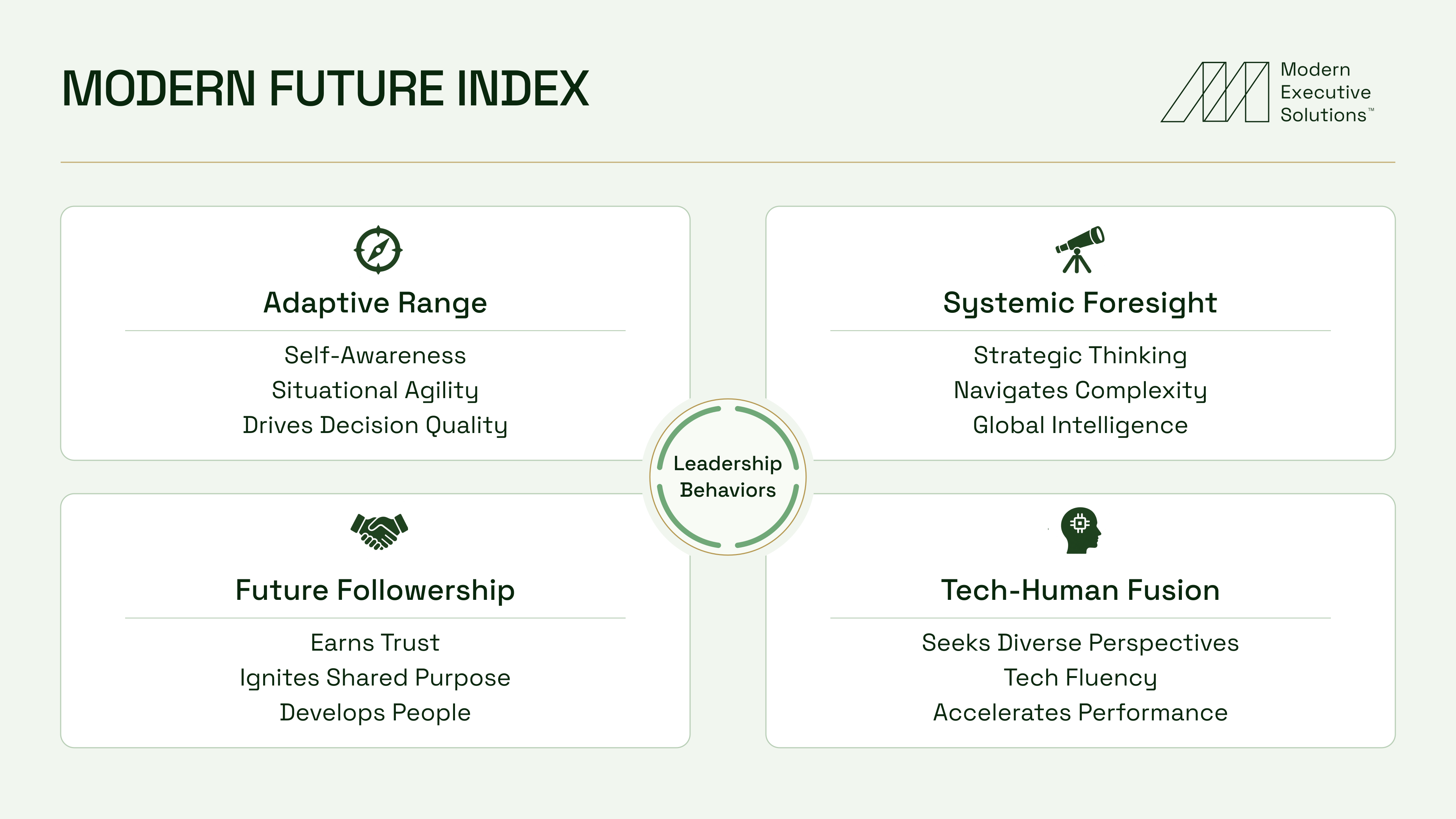
Tech Fluency gives technology leaders the understanding needed to judge what technology can contribute to the business, but that judgment also depends on what others know about users, needs, and constraints. Seeks Diverse Perspectives brings that knowledge into the decision, connecting technical understanding with the collaboration and communication emphasized in the profiles. Yet a well-informed decision still needs the conditions that allow people to deliver its value, which is where Accelerates Performance extends the focus to clear expectations, aligned resources, and accountability for business results. This connects the judgment leaders shape with colleagues to their responsibility for what the business ultimately gains.
Select and develop leaders for the work ahead
The practical question for organizations is how these expectations should shape the technology leadership roles they are preparing to fill. At Modern, we address that question by defining each role around the business’ future needs, then building a success profile that guides selection and development. Our approach is to:
- Clarify what the business will need from technology. Start with the organization’s strategy and how technology will need to support it, then establish the outcomes, responsibilities, and decisions the technology leadership role will carry as those demands change.
- Define what the technology leader will need to bring. Translate those responsibilities into requirements for technical knowledge and experience, leadership competencies, and personal attributes. The MFI helps clarify future leadership demands, while the organization’s strategy, culture, and operating context make the success profile specific to the role.
- Establish how to assess technology leaders against those requirements. Agree on the evidence needed to understand both technical capability and leadership effectiveness, drawing on technical and behavioral interviews, assessments, performance information, and stakeholder input as appropriate. Bringing that evidence together helps clarify strengths, potential risks, and development needs in relation to the role, informing selection and preparation for its responsibilities.
Where that evidence reveals gaps, we then shape development around the capabilities the technology leader needs to build. Choosing approaches suited to those needs and connecting practice, feedback, and learning with others to the leader’s actual work helps new behaviors take hold over time.
As technology expands what businesses can do, its value depends on leaders who help people understand the possibilities, question assumptions, and turn decisions into results. Preparing for the next wave of technology means developing the human capabilities that make those results possible.
If your organization is reconsidering what its technology leaders will need to do next, we would welcome a conversation about defining those roles and supporting the growth they require.