.png)
Built for Disruption: Why Change-Ready HR Leaders Are the New Definition of Success



The “success profile” used in executive searches for senior HR leaders is being rewritten, and fast. Used in recruiting, performance management, and talent development, this comprehensive outline of competencies that lead to successful performance serves as the basis for a new analysis that reveals a striking pattern: Companies are far less concerned about traditional HR expertise than they are about leaders who can drive transformation in uncertain, AI-disrupted environments.
An exclusive AI-powered analysis of 39 “success profiles” from executive HR searches (director-level and above) conducted between June 2024 and October 2025 by Modern Executive Solutions identified 18 themes that capture the most frequently cited HR leadership characteristics. Through expert review, these themes were found to align closely with the attributes that contribute to managing change and driving transformation in disruptive environments.
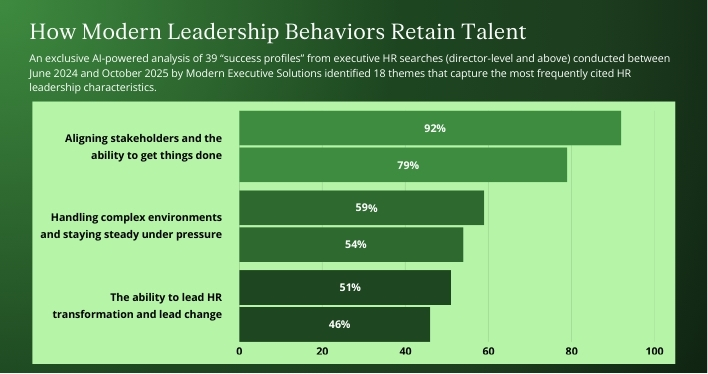
Aligning stakeholders and the ability to get things done were cited as essential skill sets for HR executives in 92% and 79% of the success profiles, respectively. Handling complex environments and staying steady under pressure registered at 59% and 54% of the profiles, underscoring the leadership skills needed in a landscape dominated by constant change, growing scale, and globalization. The ability to lead HR transformation and lead change were explicitly mentioned in 51% and 46% of searches, respectively.
The analysis throws into stark relief the demands companies are placing on their top HR leaders, which continue to go well beyond expectations for talent acquisition aptitude, compensation and benefits know-how, and compliance expertise. The demand for change management leadership skills is a reminder that these jobs are no longer just about being an HR expert. They’re about navigating a cross-functional set of human and now digital workers, bringing them together, setting a strategy, and delivering it with business performance in mind.
The upshot? Today's HR leaders are being asked to transform their organizations while running them at the very same time.
The Rise of the Dedicated HR Transformation Role
Perhaps nothing captures this moment more clearly than the emergence of a role that barely existed 18 months ago: the dedicated HR transformation leader.
Twelve months ago, these jobs did not exist or were handled as parts of people’s jobs much lower in the organization. Just one year later, Modern is increasingly getting requests to fill fully dedicated HR transformation roles that report directly to the Chief People Officer. At the top of the organization, in particular, HR transformation has been incredibly top of mind in new searches and the capabilities we’re being asked to find.
At the center of the shift is artificial intelligence, which has rapidly moved from a future concept to a present-day force shaping how organizations operate. But it’s not just the technology itself driving the push for more change management leadership in HR. It’s that you can't talk about AI without talking about how it’s impacting your operating model, changing the work people do, and shifting the number of people you need to do it. As a result, more of these transformation roles are landing on HR teams rather than IT or strategy offices. The shift is fundamentally about people, organizational design, and new ways of working.
Action Over Analysis
The data reveals another telling insight: Organizations are placing a premium on execution speed over perfectionism.
"Get things done" appears more frequently than "decide with data and evidence” at 79% versus 49%. Data literacy is important, but in a rapidly changing environment, the ability to move quickly and adapt matters more than waiting for complete information.
Similarly, stakeholder alignment (92%) significantly outpaces the importance of individually representing the culture (10%), suggesting an emphasis on actively bringing people together rather than symbolic culture expression. The daily work of bringing disparate groups together, such as operations, technology, business units, and finance, is increasingly expected to serve as organizational glue.
What emerges from the data is a leadership profile grounded in action rather than abstraction, where strategic thinking is inseparable from execution. They want leaders who can work across the entire company (67%), demonstrate a business mindset (59%), grow and empower talent (76%), and stay steady under pressure (54%). The throughline is an expectation that strategic HR leaders operate effectively amid complexity, not in spite of it.
The Paradox of Modern Leadership
The same signals that clarify leadership expectations also expose how paradoxical those expectations are in practice. Today's HR leaders must be simultaneously operational but transformational, collaborative but decisive, and empowering but directive. Holding these multiple tensions at once has become an essential leadership characteristic.
It can also look like gear-shifting, or adapting leadership styles to what the moment requires, reflecting the dual leadership roles increasingly in demand. The hard part for leaders today is running the place and changing it at the same time, and few leaders consistently excel at both enormous tasks. Thus, companies need to be explicit about which demands their hires realistically cover and how the remaining parts of the tensions are addressed elsewhere: for example, through complementary teams, systems, and increasingly, AI.
Indeed, as AI democratizes information, the value of knowing has given way to the value of deciding and acting on the information. Specific know-how about compensation best practices or hard HR skills in talent acquisition processes is referenced less often. The data suggests clients may seek fewer such skills when AI can provide instant answers. The premium will be on leaders who can take that foundational knowledge and use it to drive strategic change at unprecedented speed, increasingly by partnering with AI to resolve the tension between needing both deep expertise and effective judgment.
What This Means for HR Professionals
The implications are sobering. The career path that worked for the last generation, built on deep functional expertise and advancement through centers of excellence, may no longer be sufficient.
Tomorrow's HR leaders will need to deliberately build transformation skills through project-based assignments, enterprise-wide initiatives, or even lateral moves into strategy or operations roles. It means staying externally networked and understanding what's happening in other industries rather than remaining siloed.
Organizations are turning to HR as a central driver of change and transformation. In many ways, this builds on years of growing recognition that great strategy can only be realized through people and leaders. In today’s environment of unprecedented change, the ability for individuals and teams to adapt is more important than ever. As a result, HR leaders continue to have the unique opportunity to fundamentally shape their organizations' future success.